Why Every Golf Sim Chicago Build Uses a Big Moss Hitting Mat
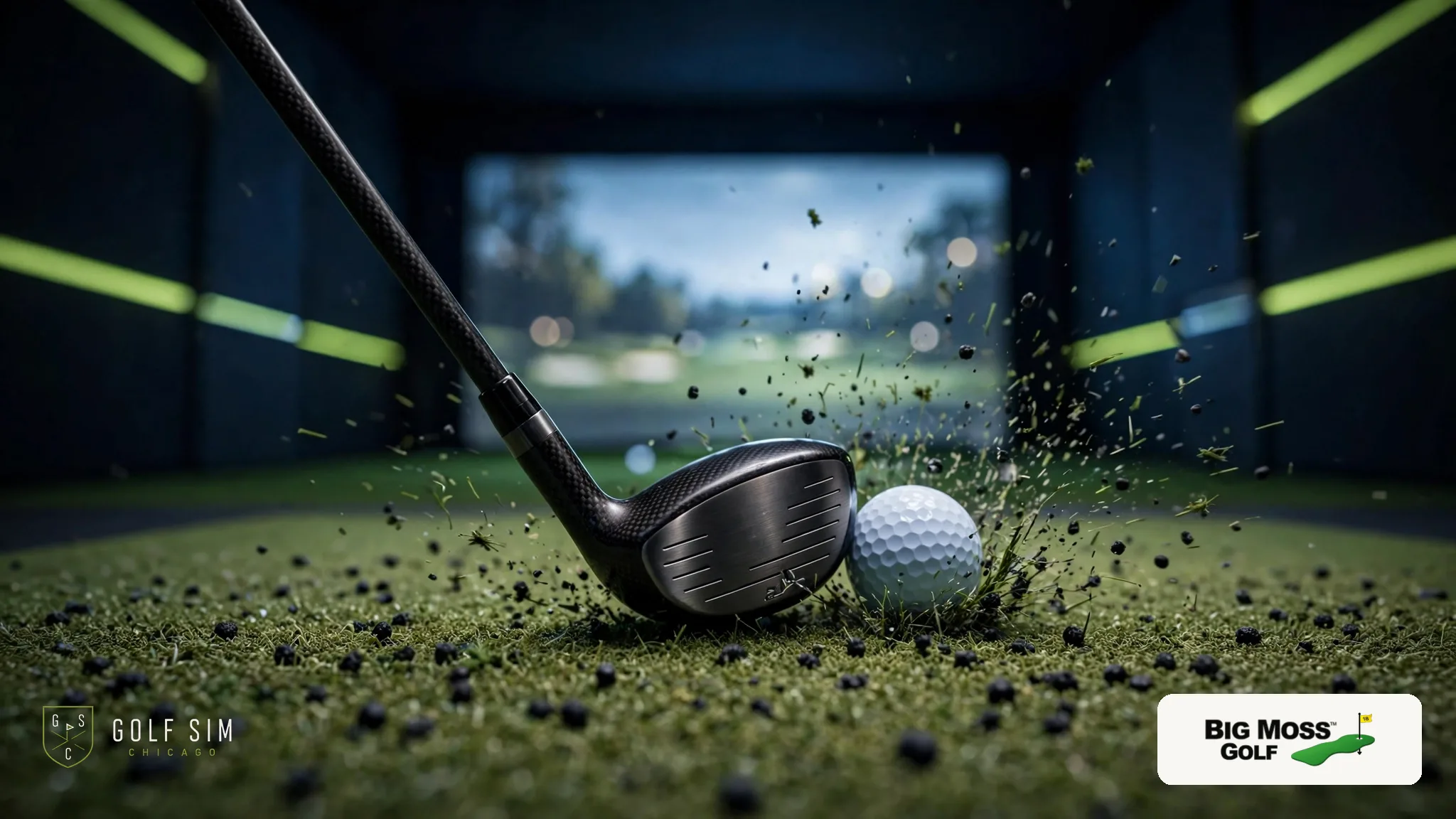
If you're planning a golf simulator, you're probably obsessing over the launch monitor. TrackMan or Uneekor? That's the fun debate. But here's the thing nobody tells you: the piece of equipment you'll physically touch on every single swing isn't the launch monitor. It's the golf simulator mat.
And most mats are terrible.
What goes wrong with a cheap mat
A bad hitting mat doesn't just feel cheap — it changes your swing. Thin turf over concrete gives you harsh, jarring contact. Your elbows and wrists pay for it over thousands of swings — "sim elbow" is a real thing. Worse, some mats grab the club and others let it skip through, so the feedback you get isn't real. You end up grooving a swing that only works on that mat.
Then there's the durability problem. A budget mat in a home simulator getting hit daily starts shedding, tearing, or going bald in the hitting zone within a year. Now you're buying another one — and ripping up part of your build to replace it.
When we design a room that's supposed to last a decade, the mat has to last a decade.
What to look for in the best golf simulator mat
After installing enough of these, the checklist is short — whether you call it a hitting mat, a hitting strip, or a hitting surface:
- Realistic turf interaction. The club should go down after the ball the way it does on grass — a real divot-like feel — not bounce off a trampoline, not dig into a rug.
- True ball data. The mat shouldn't add weird spin or launch artifacts that your launch monitor then faithfully reports as your swing.
- Durability. Thousands of swings a year, year after year, without the hitting zone falling apart.
- It has to look right. This is going in a finished room you spent real money on. A fraying mat ruins the whole aesthetic.
Why Big Moss won
Big Moss Golf has been handcrafting hitting surfaces in Spring Grove, Illinois since 1998 — about an hour from Chicago. We didn't pick them because they're local, but it doesn't hurt.
Their Pure Flight surface is the standout: instead of relying on a foam base under the turf, the nylon fibers are spun into a thatch-type base that lets the club compress through the ball the way real turf does. You get realistic feel at impact instead of the dead bounce you get from foam-backed mats. Their True Launch line pairs a lower pile height with a thicker base pad, which is what keeps launch angles and spin numbers honest — the data your launch monitor reads is actually your swing, not the mat interfering.
In our installs, that's the difference clients notice immediately. The first time someone takes a divot-less swing off a Big Moss mat after hitting off a range mat their whole life, they get it.
A real partnership, not a logo
We sat down with Tony, the owner of Big Moss Golf, recently — and the conversation confirmed what we'd already concluded from installing his mats. We're a Trusted Big Moss Partner, which mostly means two things: we buy our mats direct from him, and every complete build we install ships with a genuine Big Moss hitting surface. No substitutions, no "mat equivalent."
If you're buying a mat on your own — for a net setup in the garage, say — here's what to avoid: anything under an inch of total pile-plus-base thickness, anything with no real base pad (turf glued to rubber backing is a red flag), and anything the seller can't tell you the expected lifespan of in swings, not years.
Golf simulator mat FAQs
What's the best mat for a golf simulator?
The best golf simulator mat gives you realistic turf interaction — the club compresses through the ball like real grass — without adding false spin or launch data. It should survive thousands of swings a year without the hitting zone breaking down. That's why we install Big Moss mats in every build.
What Big Moss product do you install in your builds?
We install the Big Moss Pure Flight hitting strip — the thatch-base surface that gives realistic compression at impact — paired with their True Launch mat base for honest launch and spin numbers. It's the combo we'd put in our own homes.
How thick should a golf simulator hitting mat be?
Look for at least an inch of combined pile and base. Anything thinner, or turf glued straight to a rubber backing with no real base pad, will feel harsh and wear out fast.
Can you use a regular golf mat in a simulator?
You can, but most range mats are built for price, not realism — they grab or skip the club unnaturally, which teaches a swing that only works on that mat. If the mat is fighting your launch monitor's data, the whole setup suffers.
The bottom line
The launch monitor gets the glory, the screen gets the photos, but the mat is what your body meets 100 times a round. It's the cheapest place to ruin a great build and one of the cheapest places to get it right.
Golf Sim Chicago designs and installs custom golf simulators across Chicago and the surrounding suburbs. Every complete build features genuine Big Moss hitting mats.